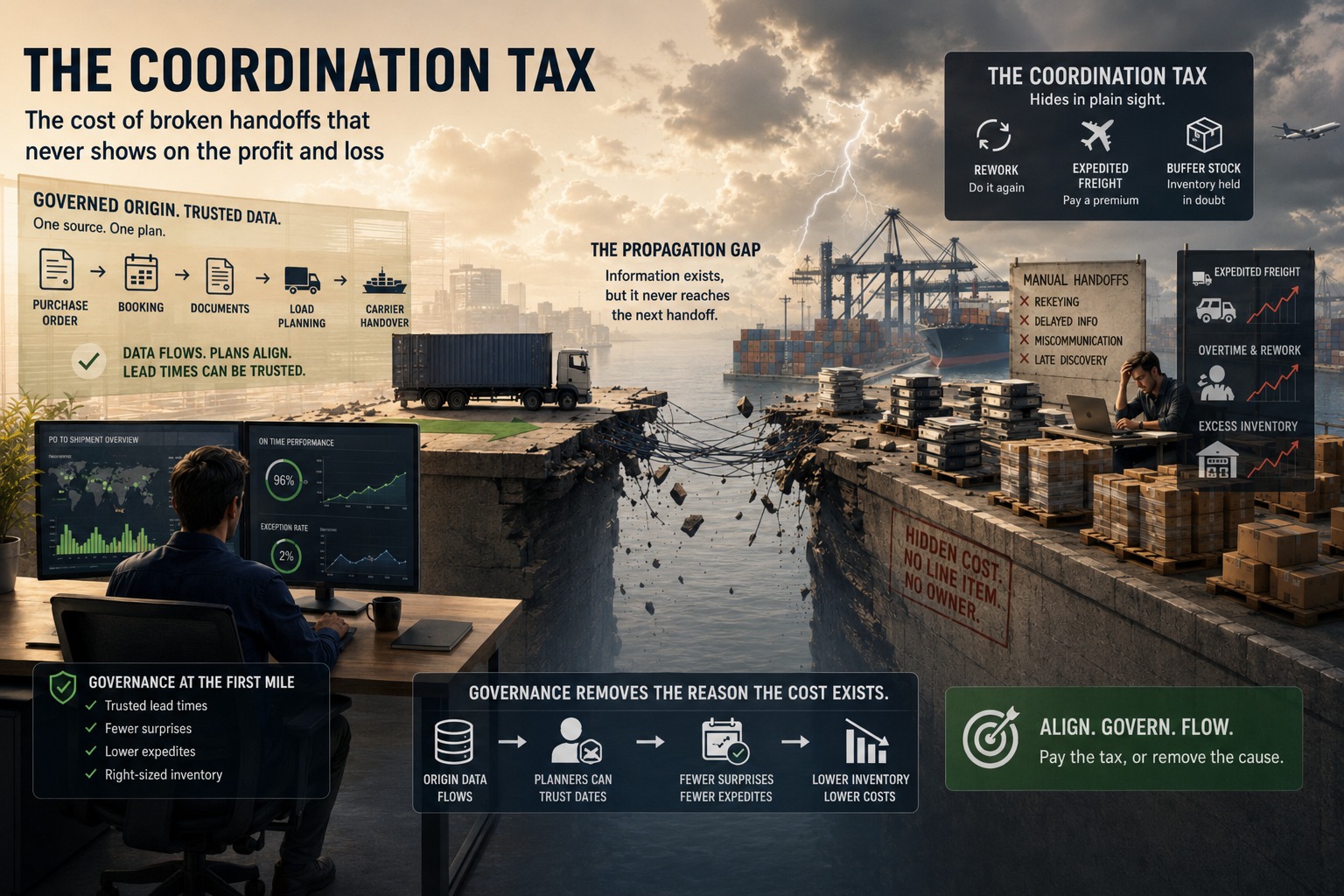


Everyone can name the first mile. Almost no one can name its owner.
Ask an operations team where their first mile is and the answer comes fast: the origin leg, from purchase order confirmation to carrier handover. Ask who owns that leg and the room goes quiet.
The easy reading is that this is an org-chart problem, so the fix is to appoint someone: a first-mile manager, a new box, a new title. I read it differently. The first mile has no owner because it cannot have one in the usual sense. Its work runs across companies, not departments, and no single firm can appoint a manager over the others.
Split four ways
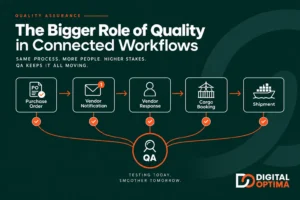
Procurement owns the purchase order. The forwarder owns the booking. The supplier owns readiness. The warehouse owns receipt. Each does its part, and each part has a name attached. The gaps between the parts have none.
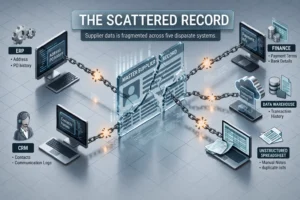
That is where the leg actually slips. A confirmation that arrives but is never passed on. A booking made against quantities that changed last week. A document that exists in one company’s system and nowhere else. Responsibility split four ways approaches no responsibility, and every improvement stalls at a handoff.
Why the usual fix fails
Inside one company, you would centralize: one department, one boss, done. Across companies, that option does not exist. The supplier, the forwarder, and the shipper are independent firms. None can be subordinated to the others, and no contract clause makes a partner care about a handoff it cannot see.
So ownership of the origin leg has to be constructed rather than assigned. That is a governance task, not a staffing one.
What constructed ownership looks like
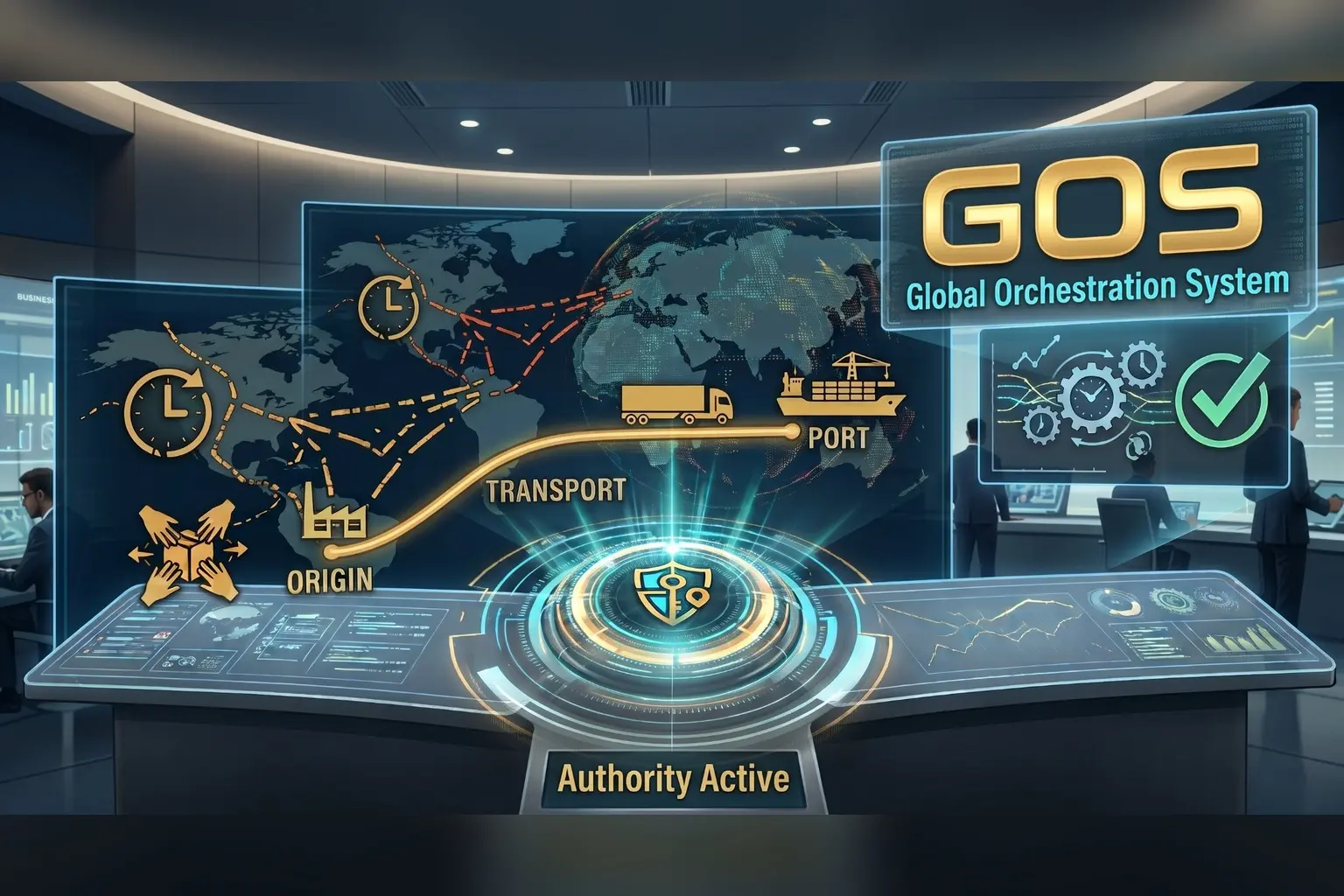
It takes four elements. One accountable owner of the leg, with real decision rights when it slips. One shared record that supplier, forwarder, and shipper all work from, instead of three private copies. Origin data that propagates into planning without rekeying. And defined handovers, with acceptance criteria and a consequence when they are missed.
None of these is a dashboard. Each is an agreement about who acts, on what, and when. Digital Optima reports that teams working this way catch issues about 48 hours earlier and save two to three hours per user each week. The gain does not come from seeing more. It comes from someone being allowed to act on what everyone already sees.
So the test for your own origin leg is short.
When it slips this week, and it will, who is allowed to act, and what makes them?
References
Digital Optima, reported platform outcomes (issues identified ~48 hours earlier; 2–3 hours saved per user per week), as published on digitaloptima.com. https://digitaloptima.com/
Wyciślak, S., Real-Time Visibility in Supply Chain Management, Routledge, 2024. https://www.routledge.com/Real-Time-Visibility-in-Supply-Chain-Management-Theories-Technologies-and-Tensions/Wycislak/p/book/9781032524832