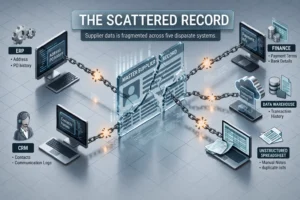


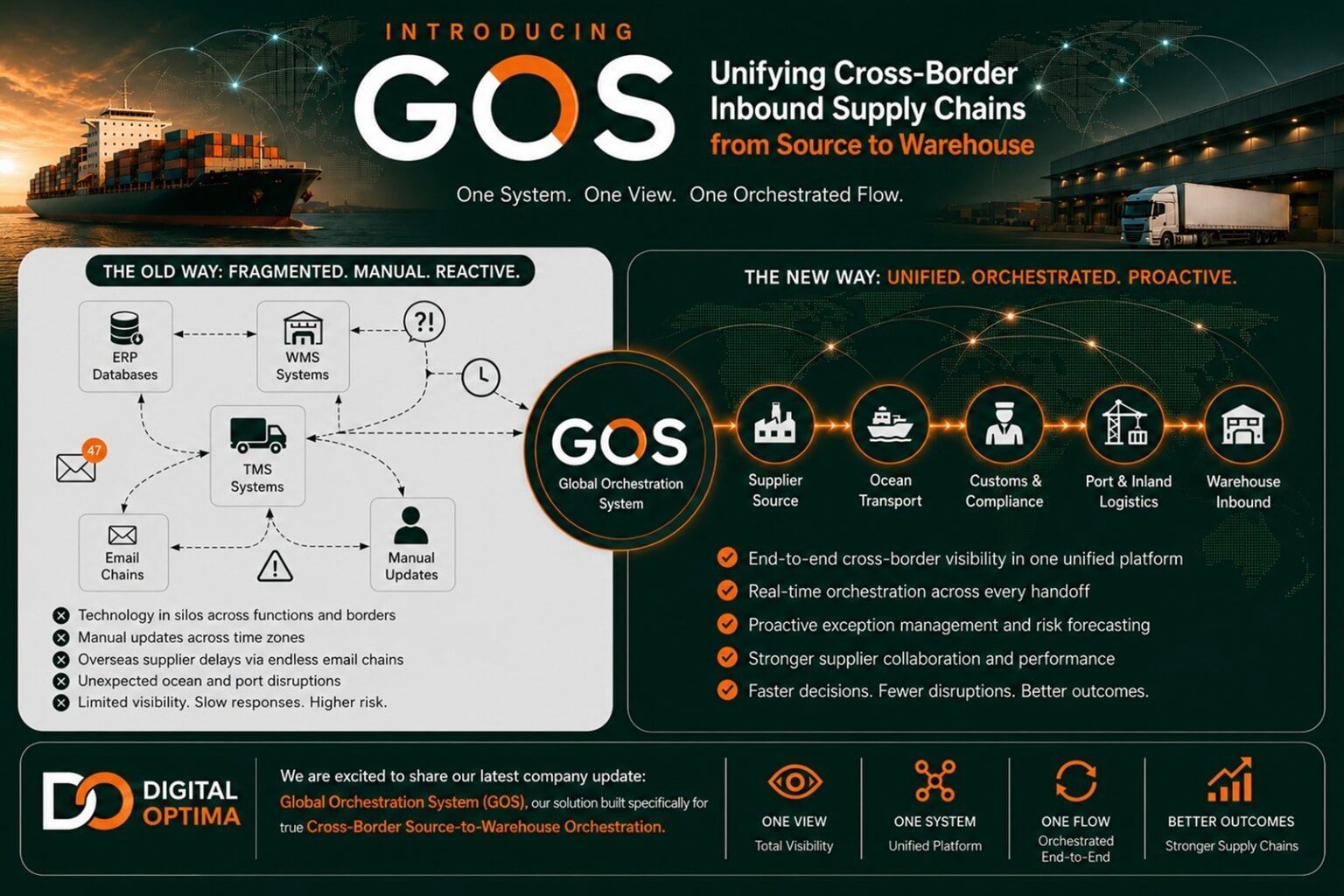
Cross-border inbound supply chains have always run on systems that were never built to talk to each other. Warehouse Management Systems, Transportation Management Systems, and ERP databases each do their own job well, but they leave wide gaps across international borders.
Operations teams are left to close those gaps by hand: stitching together updates across time zones, chasing overseas supplier delays through long email chains, and reacting to port and ocean disruptions after they have already hit.
Today we are introducing GOS, the Global Orchestration System, built specifically for cross-border source-to-warehouse orchestration.
From passive alerts to active orchestration
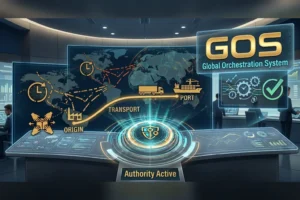
GOS orchestrates the entire global inbound journey, unifying overseas supplier networks, sea and air carriers, and destination warehouses and factories into a single collaborative operating system.
It marks a deliberate shift from being told after something breaks to resolving it before it does. Traditional tools alert you once a disruption has already landed. GOS sits above your software stack as the coordinating layer, synchronising your entire network against the purchase order and resolving exceptions in real time.
How GOS fits into your stack
GOS does not replace the systems you have invested in. It conducts them.
The System of Record (ERP) stays the financial and transactional source of truth. GOS reads from it and never overwrites it.
The Execution Layer (WMS, TMS, DOM) keeps handling the localised, tactical work, from put-away routines to local routing and order processing.
The GOS Layer, the conductor, sits above the stack. It ingests multi-tier partner data, tracks end-to-end dependencies against each purchase order, and triggers the right workflow the moment variables change at origin or in transit.
See how GOS fits into your stack
Connectivity without friction
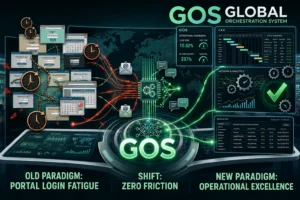
Multi-enterprise software usually fails for one reason: external partners refuse to learn another portal. GOS removes that barrier by meeting suppliers where they already work.
No mandatory logins. Suppliers, forwarders, and logistics partners engage through email and mobile chat, participating in workflows straight from their inbox. That drives network-wide engagement without the change-management fight.
AI-driven parsing. GOS reads unstructured data from emails and chat, then maps and validates it automatically. Operational variations escalate to your team for review, so manual data entry disappears from the shipment journey.
Quick wins first. By solving small, immediate pain points through frequent releases, GOS builds the trust stakeholders need to champion the wider rollout.
One PO, end to end. Every supplier update, carrier milestone, and warehouse receipt maps back to the purchase order, so there is one thread to follow instead of ten.
Real operational value
By connecting the first-mile supplier floor directly to warehouse receiving, GOS delivers measurable results:
75% reduction in order-tracking admin. Reclaim 15+ hours per team every week. Automated data capture and real-time supplier updates eliminate manual spreadsheet maintenance, allowing teams to pivot from firefighting to strategic execution.
35% compression in total lead times. Trim up to 10 days off your door-to-door cycle. Proactive exception management resolves authority and documentation issues before cargo leaves origin, reducing the need for costly buffer inventory.
20%+ reduction in total freight spend. Save $200k for every $1M in logistics spend. Automated line-item auditing and proactive dwell alerts stop demurrage, detention, and carrier billing errors before they erode your margin.
The agentic first mile
As the industry races toward autonomous AI and automated workflows, a new risk is emerging: the agentic first mile.
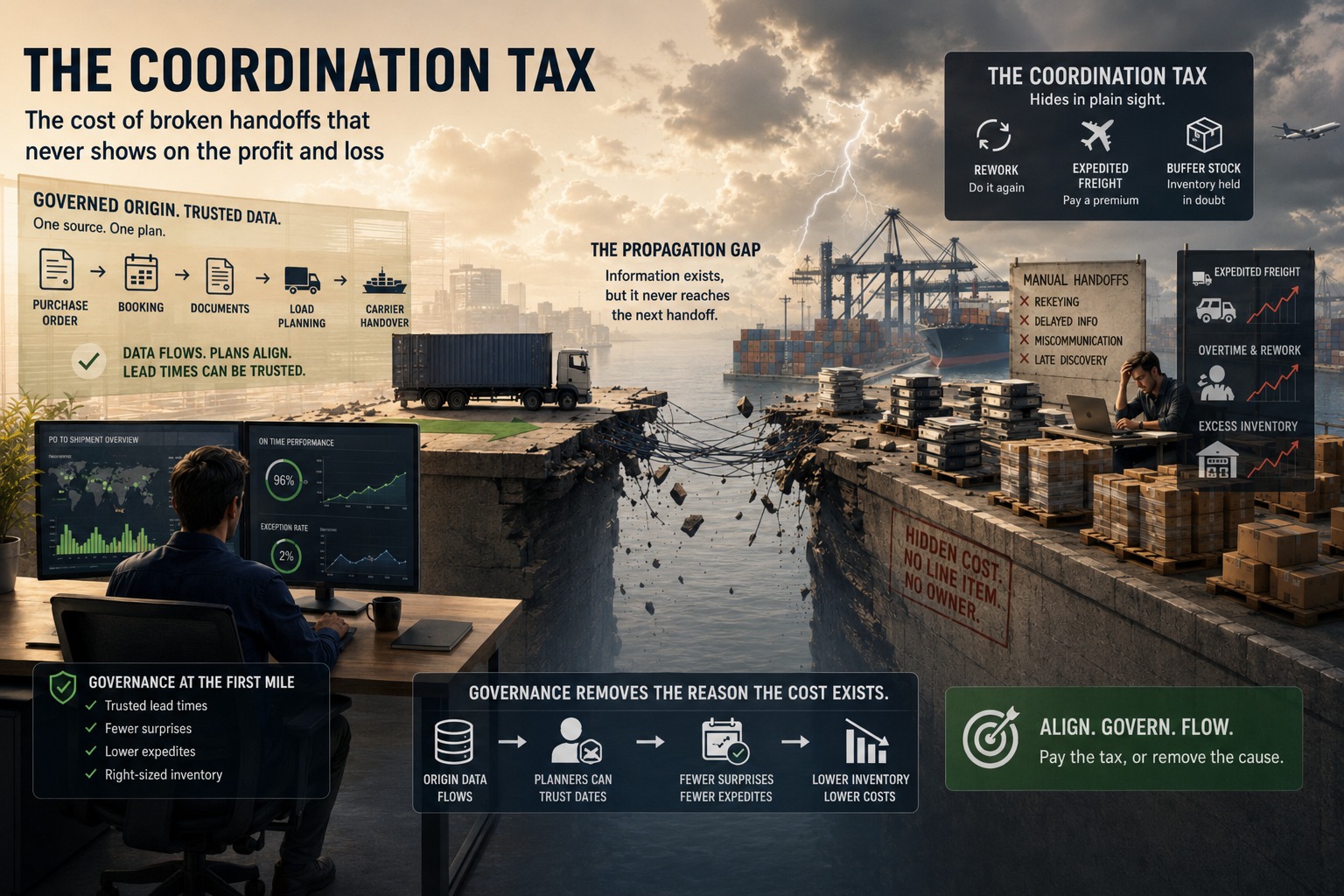
Point an AI agent at the least governed part of the supply chain and it does not repair a broken handoff. It inherits it, then acts on flawed data at machine speed. Automating a broken handoff removes the moment an experienced operator would once have caught and corrected the error. The risk is amplified because so much of the mid-market first mile still runs on unstructured emails, spreadsheets, and manual booking.
This is why GOS is foundational. Before you deploy autonomous execution, GOS supplies the structured governance, friction-free data capture, and expert oversight that sanitise first-mile handoffs, so machine-speed automation accelerates accuracy rather than chaos.
The future of global supply chains
The era of managing cross-border logistics through siloed systems, unstructured inbox threads, and ungoverned scripts is closing. With GOS, cargo owners gain the active architecture that turns the volatile first mile into a predictable, streamlined competitive advantage.
Explore the Global Orchestration System or book a demo to see it applied to your inbound network.