One operating layer for cross-border inbound, from the supplier floor at source to the warehouse dock at destination. GOS coordinates every purchase order across suppliers, carriers and warehouses, so your team stops stitching updates together by hand.
Common freight forwarder and CFS risks include:
The first mile is fragmented
Much of the mid-market first mile still runs on unstructured emails, spreadsheets and manual bookings. The data your PO depends on is never governed at origin.
Alerts arrive after the fact
Traditional tools tell you a shipment slipped once it has already slipped. By then the decision that could have prevented it has passed.
Coordination falls to people
Every exception becomes a manual thread. Operations teams firefight instead of executing, and the cost compounds across every order.
Your systems manage tasks Nothing manages the handoffs between them.
WMS, TMS and ERP each run their own slice well. Across international borders, the space between them is left to people. Teams reconcile updates across time zones, chase overseas supplier delays through email chains, and absorb port and ocean disruptions after the fact.
Systems record what happened inside their own boundary and notify you once a disruption has already landed.
The network resolves it before it breaks
GOS synchronises suppliers, carriers and warehouses against the purchase order, and triggers the next action the moment a variable changes at origin or in transit.
Today
Reacting to the Breakdown
Legacy systems lock data inside isolated silos and send alerts long after the damage is done.
With GOS
Resolving Before the Breakdown
GOS unifies your entire supply network around the purchase order, instantly triggering corrective actions the second transit or origin conditions shift.
How GOS fits
GOS does not replace your stack. It conducts it.
Keep the systems you have already invested in. GOS sits above them as the coordinating layer, reading multi-tier partner data and driving workflows the moment reality changes.
System of Record (ERP)
Stays the financial and transactional source of truth. GOS reads from it, never overwrites it.
Execution Layer (WMS, TMS, DOM)
Keeps handling the localised, tactical work: put-away routines, local routing, order processing.
GOS (The conductor)
Sits above the stack. Ingests multi-tier partner data, tracks end-to-end dependencies against each PO, and triggers the right workflow when variables shift at origin or in transit.
Multi-enterprise software fails when external partners refuse to learn another portal. GOS meets suppliers, forwarders and logistics partners where they already work.
No mandatory logins
Suppliers and forwarders engage through email and mobile chat, participating in workflows straight from their inbox. Network-wide engagement without the change-management fight.
AI-driven parsing
GOS reads unstructured data from emails and chat, then maps and validates it automatically. Operational variations escalate to a person for review, so manual data entry disappears from the shipment journey.
Quick wins first
Frequent iteration solves small, immediate pain points early, building the trust stakeholders need to champion the wider rollout.
One PO, end to end
Every supplier update, carrier milestone and warehouse receipt maps back to the purchase order, so there is one thread to follow instead of ten.
Connect the supplier floor to the warehouse dock, and the numbers move.
Your supply chain data is scattered across spreadsheets, inboxes, and legacy systems, creating an invisible barrier to execution.
0%
Reduction in Order-Tracking Admin
Reclaim 15+ hours per team every week. Automated data capture and real-time supplier updates eliminate manual spreadsheet maintenance, allowing teams to pivot from firefighting to strategic execution.
0%
Compression in Total Lead Times
Trim up to 10 days off your door-to-door cycle. Proactive exception management resolves authority and documentation issues before cargo leaves origin, reducing the need for costly buffer inventory.
0%+
Reduction in Total Freight Spend
Save $200k for every $1M in logistics spend. Automated line-item auditing and proactive dwell alerts stop demurrage, detention, and carrier billing errors before they erode your margin.
The agentic first mile.
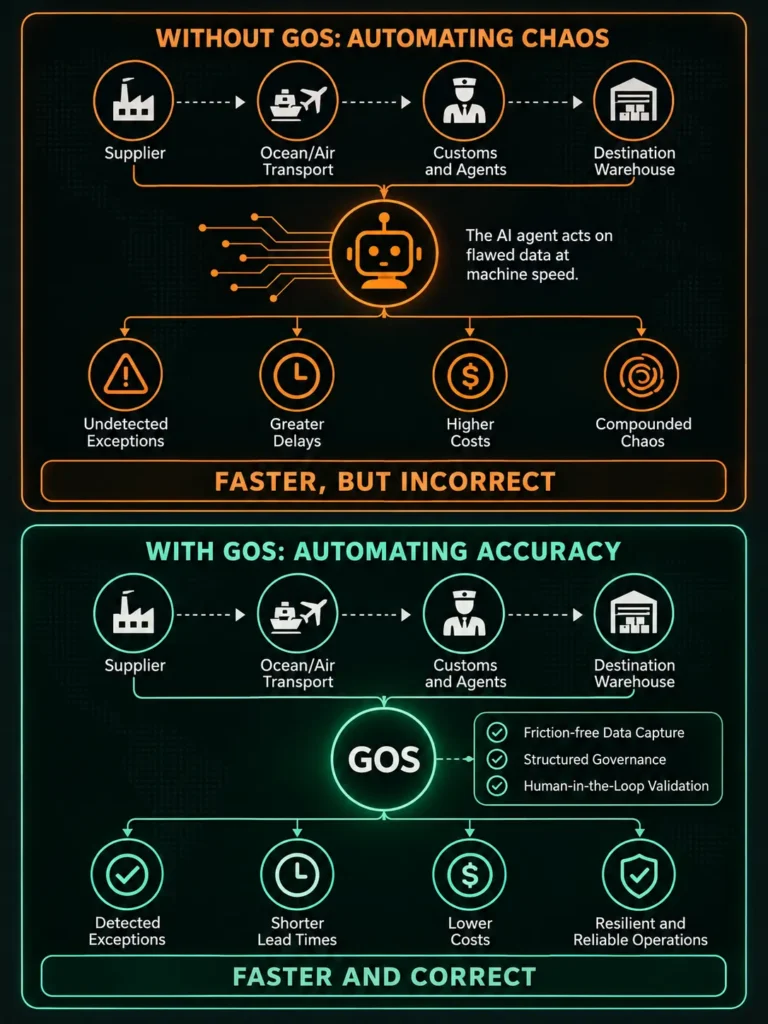
Point an AI agent at the least governed part of the supply chain and it does not repair a broken handoff. It inherits it, then acts on flawed data at machine speed.
Automating a broken handoff removes the human pause, the exact moment an experienced operator used to catch and correct a manual error. The risk is amplified because so much of the mid-market first mile still runs on unstructured emails, spreadsheets and manual booking.
This is why GOS is foundational. Before you deploy autonomous execution, GOS supplies the structured governance, friction-free data capture and human-in-the-loop validation that sanitises first-mile handoffs, so machine-speed automation accelerates accuracy, not chaos.