

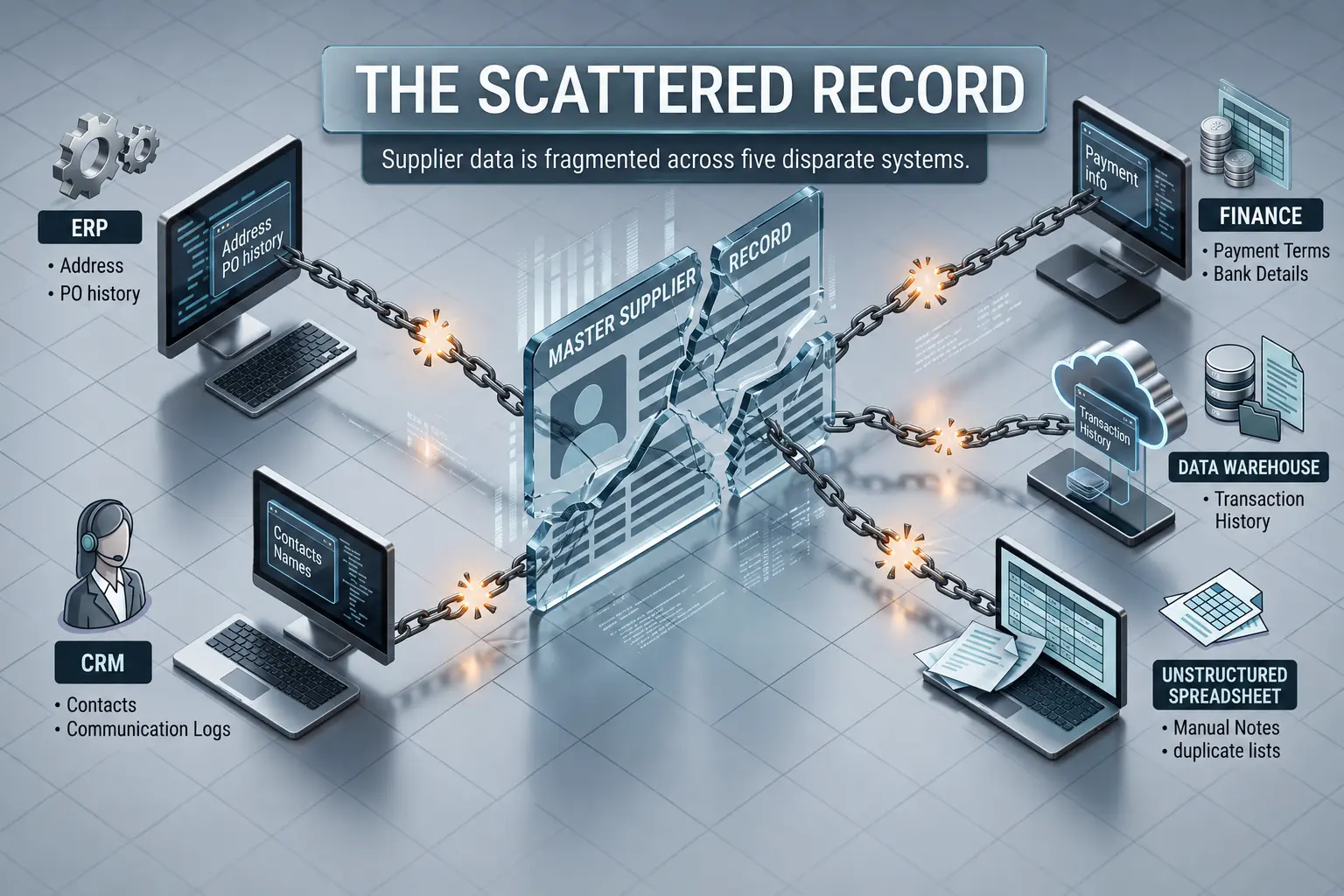
Supplier data lives in five systems. Whether it is complete lives in none of them.
Take one supplier relationship and count the documents it generates: onboarding forms, compliance certificates, sustainability declarations, invoices, shipping documents. Now count the systems they live in. In most companies the second number is nearly as large as the first.
The easy reading is that this is an integration problem, so the fix is another connector, another repository, another sync. I read it differently. The scattered record is a completeness problem, and completeness is exactly the property that scattering destroys.
A question with no home
Completeness is a property of the whole record. Whether a supplier’s file is complete cannot be answered from inside any one system, because each system holds its own fragment and considers itself done. The compliance platform knows about certificates. The invoicing tool knows about invoices. Nobody knows what is missing, because missing only shows against the whole.
So the question goes unasked until something forces it: an audit, a sustainability report, a customs hold. Then a team assembles the answer by hand, across five logins, under deadline.
What the teams pay daily
Between those moments, the cost is quieter. Teams log into multiple platforms to serve one relationship. Onboarding stalls while documents are chased one inbox at a time. The same certificate is requested twice by two departments, which the supplier notices and remembers.
And every AI and analytics ambition waits, because you cannot compute on what you have not collected in one place.
Completeness as a tracked state
Consolidation done right is not another copy of the fragments. It is one supplier record on which completeness is a tracked state: every expected document has a status, an owner, and a due date, and the gap list writes itself instead of being discovered at audit.
Capture stays light on the supplier side, from the email and chat channels suppliers already use. The heavy lifting is definitional: deciding, once, what a complete supplier file contains. That decision is the difference between storing supplier data and governing it.
For your twenty most important suppliers, could anyone in your organization say today which documents are missing?
References
Digital Optima, Global Orchestration System (GOS). https://digitaloptima.com/global-orchestration-system/
Wyciślak, S., Real-Time Visibility in Supply Chain Management, Routledge, 2024. https://www.routledge.com/Real-Time-Visibility-in-Supply-Chain-Management-Theories-Technologies-and-Tensions/Wycislak/p/book/9781032524832