
An email notification doesn’t sound like a serious supply chain problem.
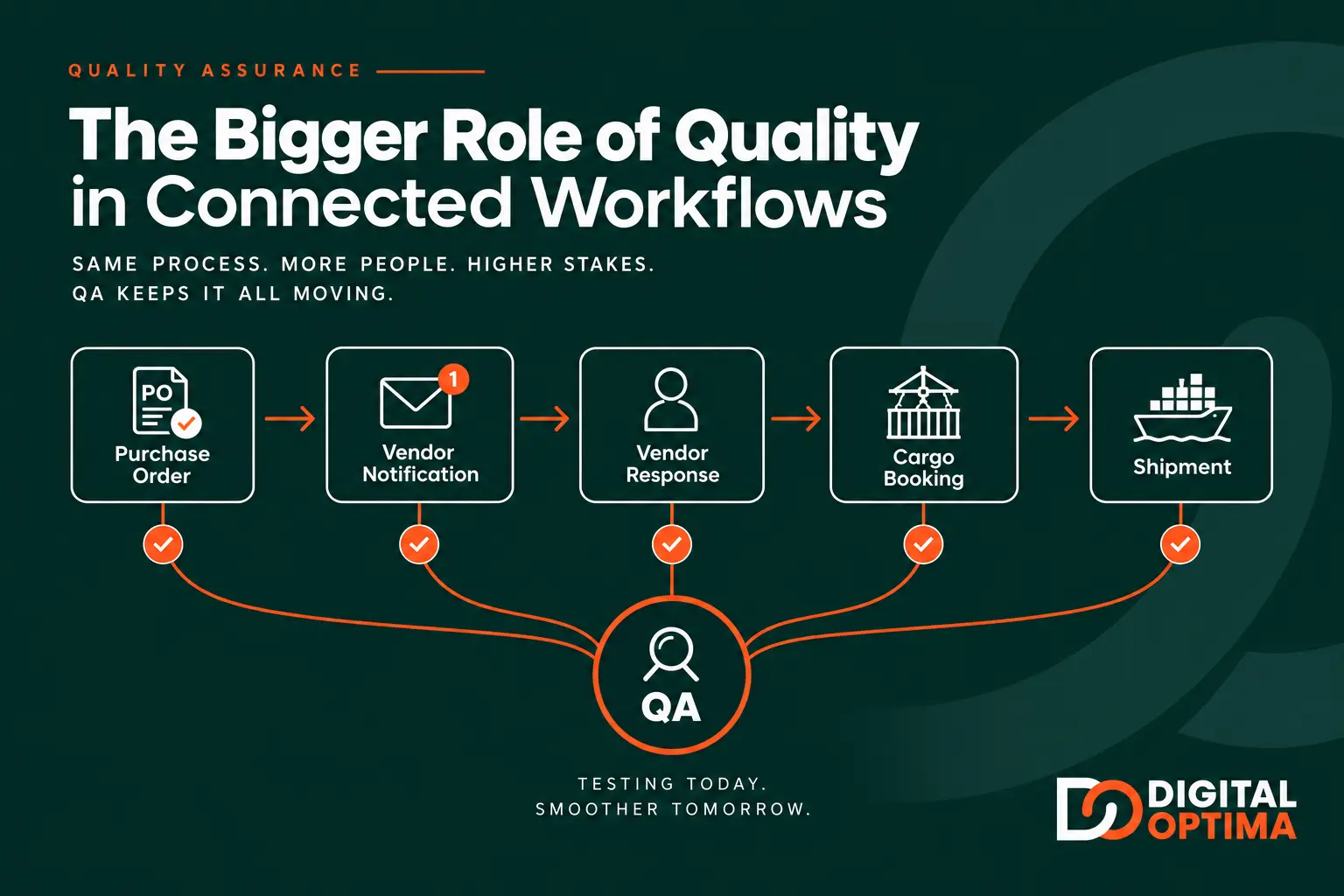
While testing a release earlier this year, we found that a purchase order had been created successfully in the application, but the vendor never received the email notification for that particular PO. The vendor would have had no indication that the PO was waiting for their action. Left undiscovered, that missed notification could have delayed the response, the cargo booking and, eventually, the shipment.
The usual reading would be simple: the email did not go out. It could be classified as a low-severity defect, logged for correction in the next sprint, and moved on from.
But the impact was larger than the defect suggested.
The missed notification was not just an email problem. It had the potential to interrupt the chain of actions that followed the PO: vendor response, cargo booking and, ultimately, shipment. QA caught the issue before that chain could begin.
This is where Quality Assurance becomes more than finding bugs.
Beyond the Screen
When we think about QA, it is easy to think about checking whether a feature works as expected. Does the button work? Does the form submit? Does the correct message appear?
Those checks are important, but they are only one part of quality.
In supply chain software, a feature rarely exists on its own. A purchase order can trigger an approval, an approval can trigger a booking, and that booking can affect a shipment.
A problem in one place can therefore create consequences somewhere else.
The User’s Lens
Supply chain software connects different users and processes. A buyer, supplier, or logistics team may each depend on different information and actions to keep the process moving.
This is where QA needs to look beyond the feature itself and understand the workflow from the user’s perspective.
Testing through the user’s lens means asking whether the right information reaches the right person, whether the next action is clear, and whether the workflow can continue without unnecessary friction.
The goal is not just to verify that the software works as designed, but to have confidence that it works the way the business needs it to.
Small Issues, Business Problems
A wrong quantity, an incorrect shipment date, a missing status update, or an incomplete search result can create manual work for someone downstream.
The software may still be technically usable, but the business process becomes slower and less reliable.
This is why seemingly small defects deserve attention. The question is not only how severe the defect looks on the screen, but what it can affect beyond it.
Confidence at Each Release
The goal of a release is not just to confirm that something new works, but to ensure it has not affected what was already working.
A new feature can have consequences beyond its intended scope. That is where regression testing matters: looking at existing workflows, user roles, business rules, integrations, and realistic scenarios to give confidence that what already worked continues to work as expected.
Users should be able to trust that the information they see is accurate, their actions will produce the expected results, and the workflows they depend on will keep moving.
In supply chain software, even a small issue can create a much larger operational ripple. That is especially true in the first mile, where purchase orders, vendor coordination, and bookings are closely connected.
So the next time a defect looks too small to matter, the better question might be: where could this problem go next?