

Forty-five percent of companies have no visibility into their upstream supply chain, or can see only as far as their first-tier suppliers. That figure is from McKinsey. The origin of the chain stays the part leaders see least.
The easy reading is that we need more visibility. Buy another tracking layer, light up another tier, and the blind spot closes. I read it differently. The first mile does not have a seeing problem. It has a governing problem, and no amount of new dashboards will fix a problem of that kind.
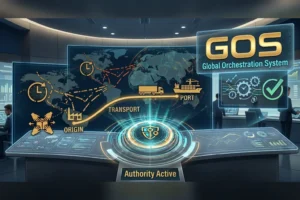
Start with what the first mile actually is. It is the origin leg, everything that happens from a purchase order being confirmed to the goods being handed to the carrier. Booking, supplier readiness, documentation, consolidation. It is the start of the journey and the part every later leg depends on. It is also the least digitised. The last mile was rebuilt around scan events and proof of delivery. The first mile still moves on email, spreadsheets, and paper.
Now look at what visibility does there. It answers one question. Where is it. That question matters, but it is a rear view by design. A shipment that is now visible as late is still late. By the time origin becomes visible, the booking, the consolidation, and the handover are already set. The data arrives after the window to act has closed. Visibility also moves work onto people rather than off them. A feed of events still has to be read, ranked, and chased by someone under time pressure. More data without more governance produces more alerts and the same outcomes.
The propagation gap
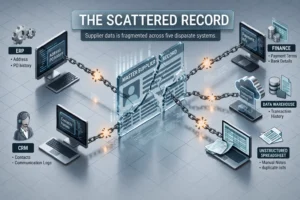
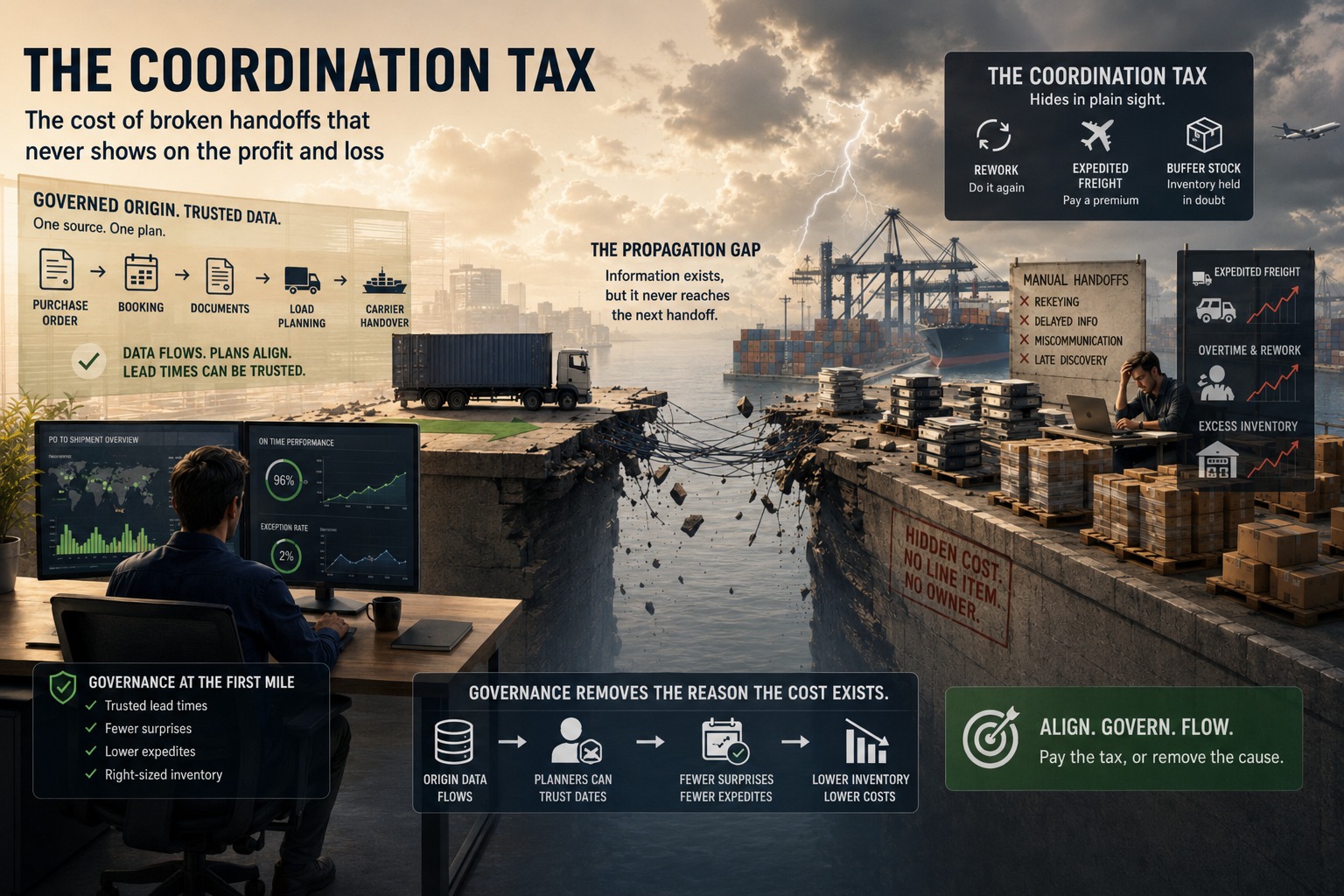
There is a quieter failure underneath all of this, and it is the one that matters most. Purchase order data is captured once, at the top, and usually captured well. Then it stops moving. It never reaches load planning. It never reaches the shipment timeline. It never reaches vendor scoring. So teams plan the rest of the journey against numbers that no longer hold, buffers grow to cover the doubt, and variances get explained after the goods have already left.
Call it the propagation gap. The data exists. It simply does not reach the point where the next decision is made. This is not a visibility problem, because the facts are already captured. It is a governance problem, because nothing carries those facts forward and holds the parties to them.
Why 2026 makes this urgent
This year the whole field is talking about the same idea. SAP and IDC have built their outlooks around agentic AI and orchestration. C.H. Robinson has launched what it calls an agentic supply chain, with a fleet of more than thirty AI agents that processed over three million shipping tasks in 2025. The promise is that software will soon coordinate the chain end to end.
Here is the catch. An agent acts on what reaches it. Point an agent at the first mile and it inherits the propagation gap, then acts on it faster. Automating a handoff that was already broken does not repair the handoff. It removes the human pause where the error used to be caught. You cannot orchestrate what you cannot govern, and the first mile is the least governed part of the chain. The race to orchestrate runs straight into it.
What governing the first mile looks like
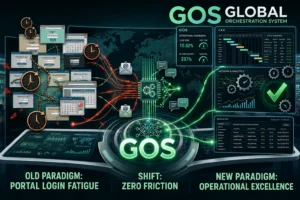
Governance is not a heavier dashboard. It is a different posture. One record of the shipment that suppliers, forwarders, and the shipper all work from. Origin data that flows into planning and performance without rekeying. Risk surfaced early enough to change the outcome rather than log it. One owner of the origin leg, with handovers that are tracked and enforced. The test is simple. Visibility lets you watch the problem form. Governance lets you act before it does.
This is the shift worth making, from a passive view to an anticipatory one. The first mile is the highest leverage and least governed part of the supply chain. Closing it is not about seeing more. It is about acting earlier, and about holding the origin leg to a plan rather than hoping it holds itself.
So the question for any team carrying real international flows is not how much of your first mile you can see. It is who is allowed to act when origin slips, and whether anything makes them.
References
McKinsey and Company, Taking the pulse of shifting supply chains, 2022. Figure on upstream visibility. https://www.mckinsey.com/capabilities/operations/our-insights/taking-the-pulse-of-shifting-supply-chains
C.H. Robinson, AI fleet surpasses 30 agents, 2025. https://www.chrobinson.com/en-us/about-us/newsroom/news/2025/ch-robinson-scales-fleet-of-ai-agents-past-30/
C.H. Robinson, AI performs over three million shipping tasks, 2025. https://www.chrobinson.com/en-us/about-us/newsroom/press-releases/2025/ai-performs-over-three-million-shipping-tasks/
SAP, Supply Chain Trends for 2026, From Agentic AI to Orchestration. https://www.sap.com/blogs/supply-chain-trends-for-2026-from-agentic-ai-to-orchestration
IDC, Orchestrating Supply Chain Ecosystems in the Age of Agentic AI. https://www.idc.com/resource-center/blog/orchestrating-supply-chain-ecosystems-in-the-age-of-agentic-ai/
Sławomir Wyciślak, Real-Time Visibility in Supply Chain Management, Routledge, 2024. https://www.routledge.com/Real-Time-Visibility-in-Supply-Chain-Management-Theories-Technologies-and-Tensions/Wycislak/p/book/9781032524832