

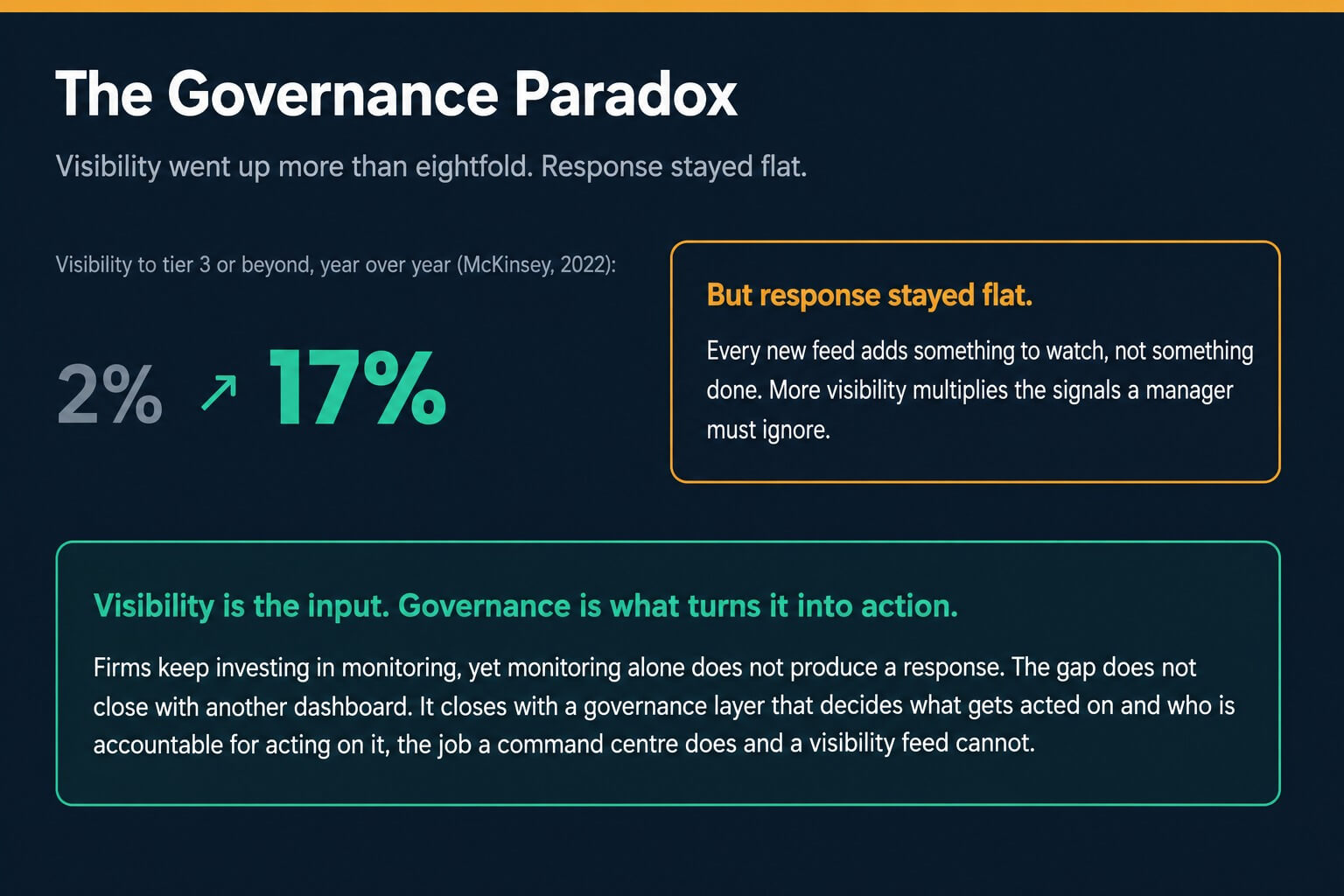
Visibility to the third tier grew more than eightfold. The response rate did not move.
In a single year, the share of companies that could see past their first-tier suppliers rose from 2 percent to 17 percent. McKinsey counted it in 2022. Visibility is improving, and the investment behind it is real.
The easy reading is that whatever gap is left is still a seeing problem, so the fix is more feeds, more tiers, more dashboards. I read it differently. The gap that is left has nothing to do with how much a team can see.
More signal, same response
Here is the paradox I keep meeting in the field. Every new data stream adds something to watch, not something done. A feed of events still has to be read, ranked, and chased by someone under time pressure. More visibility multiplies the signals a manager must ignore. So the dashboard fills up while decisions stay exactly where they were.
Why monitoring does not produce a response
This points to something visibility alone cannot fix. Firms invest in monitoring, yet investment in monitoring does not produce a response. The constraint was never how much you could see. It was whether anything turned what you saw into an owned decision. That is not a visibility problem. It is a governance problem: deciding what gets acted on, and who is accountable for acting on it once it is seen.
What governance adds that visibility cannot
Governance is not a heavier dashboard either. It is a short list, not a long feed: what needs a decision today, who owns that decision, and what happens if nobody acts. A command centre earns its keep exactly there, turning a feed nobody has time to read into a short list someone is actually responsible for closing. That is the difference between a screen and a system, and it is why the seventeen percent of companies who can now see the third tier are not automatically the ones acting on it.
So before the next visibility investment, it is worth asking a harder question than how much more can we see.
How much of the visibility you already bought has actually changed a decision, and how much just gave you one more thing to watch?
References
McKinsey & Company, “Taking the pulse of shifting supply chains,” 2022. Share of firms with visibility to the third tier or beyond rose from 2% to 17% year over year. https://www.mckinsey.com/capabilities/operations/our-insights/taking-the-pulse-of-shifting-supply-chains
Digital Optima, Command Centre platform page. https://digitaloptima.com/command-centre/
Wyciślak, S., Real-Time Visibility in Supply Chain Management: Theories, Technologies and Tensions, Routledge, 2024. https://www.routledge.com/Real-Time-Visibility-in-Supply-Chain-Management-Theories-Technologies-and-Tensions/Wycislak/p/book/9781032524832