

Agent adoption is accelerating. The data agents act on is not.
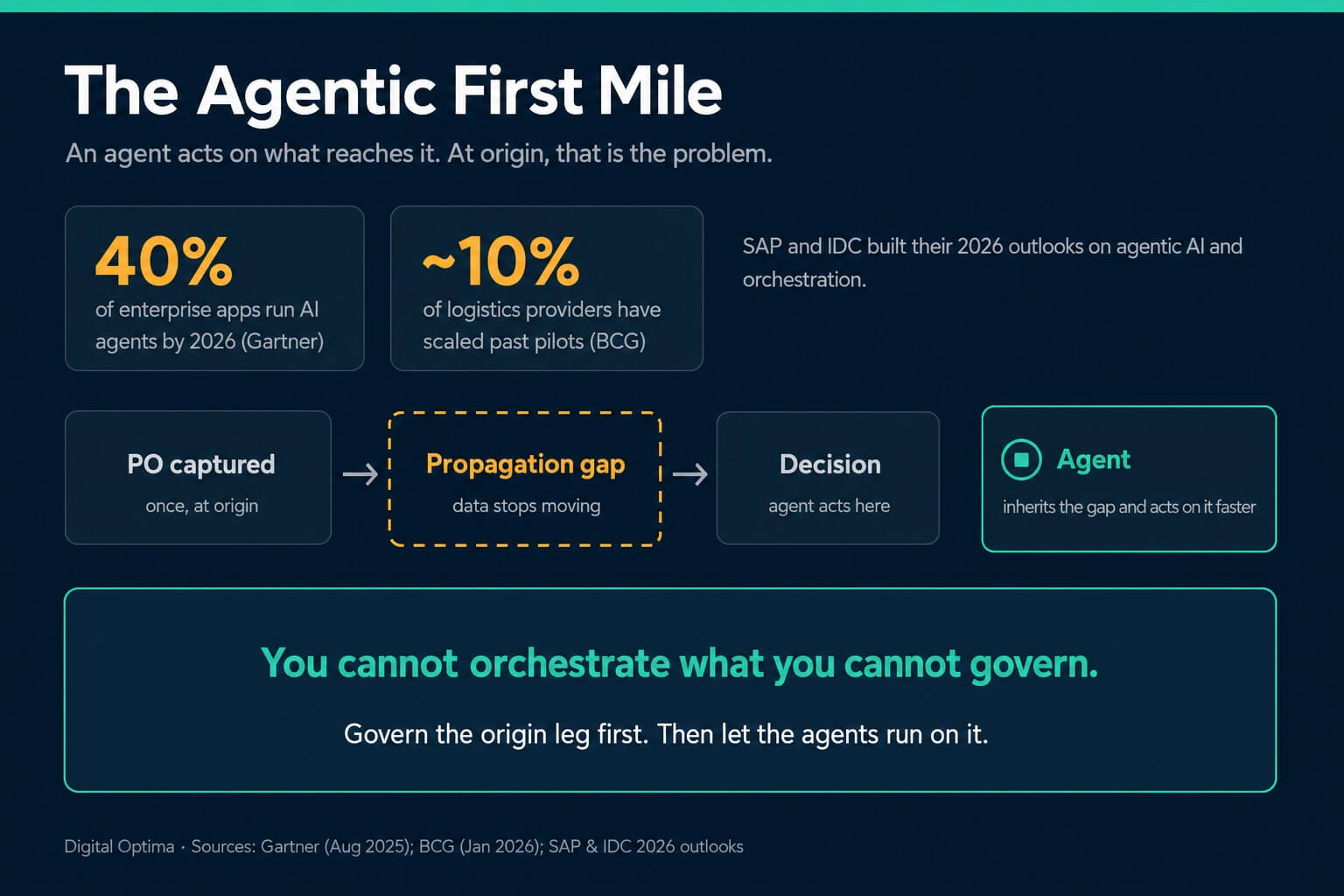
Gartner expects 40 percent of enterprise applications to embed task-specific AI agents by the end of 2026, up from under 5 percent in 2025. Supply chains sit near the front of that curve, because they generate more exceptions than any manual process can resolve at volume.
The easy reading is that faster adoption means a faster fix. I read it differently. An agent does not resolve an exception on judgment, it acts on whatever data reaches it, and for most shippers, what reaches the first mile is already stale.
Piloting is not the same as scaling
BCG’s most recent survey of logistics providers and shippers, run in January 2026 across more than 180 companies, found that about 40 percent of logistics providers have moved past the pilot stage on AI, while only around one in ten have scaled it across core operations. That gap between trying an agent and trusting it is rarely a model problem. It is a data problem, and it usually starts at origin.
An agent acts on what reaches it
SAP and IDC both built their 2026 outlooks around the same idea, that software will soon coordinate the chain end to end. I believe it will. That is exactly what worries me about the first mile.
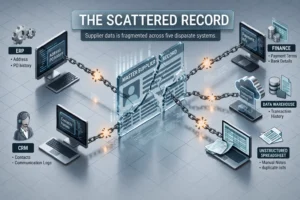
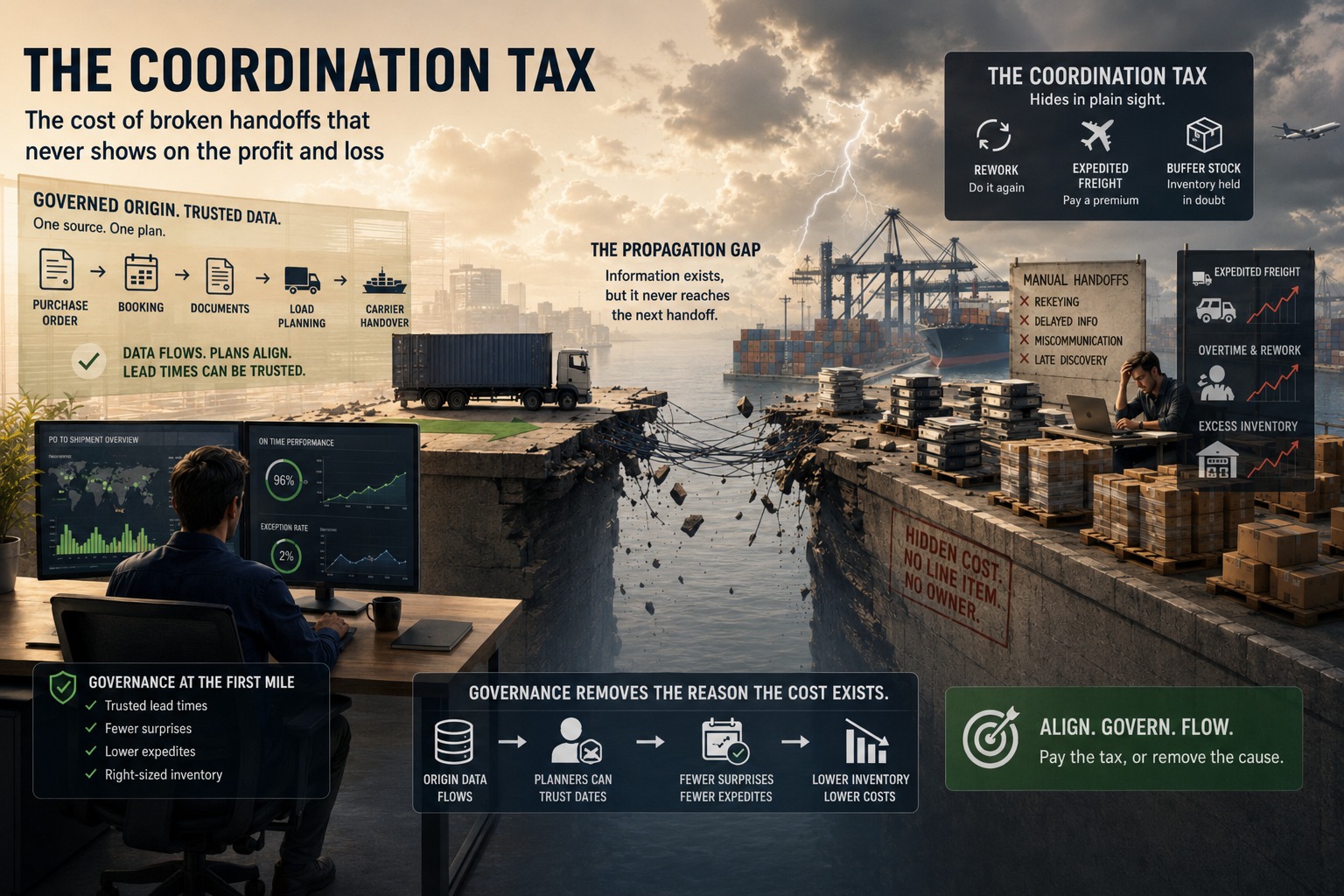
An agent acts on what reaches it. Point one at the first mile and it inherits the propagation gap, then acts on it faster. Purchase order data is captured once at origin and then stops moving, so the agent optimizes against numbers that no longer hold, and it does so at machine speed.
Automating a handoff that was already broken does not repair the handoff. It removes the human pause where the error used to be caught. The race to scale runs straight into the least governed part of the chain.
Where mid-market shippers actually stand
In the mid-market operations I speak with, the first mile is still the part of the chain run on email, spreadsheets, and manual booking, and it is the least instrumented leg an agent could be pointed at. Scaling an agent on top of that is not a shortcut past the problem. It is where the propagation gap gets automated instead of fixed.
You cannot orchestrate what you cannot govern. Before pointing agents at origin, the first mile needs one record everyone works from, origin data that propagates into planning without rekeying, and one owner accountable when it slips. Govern the leg first. Then let the agents run on it.
Would your first mile survive an agent moving at full speed?
References
Gartner, “40% of Enterprise Apps Will Feature Task-Specific AI Agents by 2026, Up from Less Than 5% in 2025,” press release, August 2025. https://www.gartner.com/en/newsroom/press-releases/2025-08-26-gartner-predicts-40-percent-of-enterprise-apps-will-feature-task-specific-ai-agents-by-2026-up-from-less-than-5-percent-in-2025
BCG, “AI Is Already Moving the Logistics Industry Forward,” report published March 2026, based on a January 2026 survey of 180+ logistics providers and shippers. https://www.bcg.com/publications/2026/ai-is-already-moving-the-logistics-industry-forward
SAP, “Supply Chain Trends for 2026: From Agentic AI to Orchestration.” https://www.sap.com/blogs/supply-chain-trends-for-2026-from-agentic-ai-to-orchestration
IDC, “Orchestrating Supply Chain Ecosystems in the Age of Agentic AI.” https://www.idc.com/resource-center/blog/orchestrating-supply-chain-ecosystems-in-the-age-of-agentic-ai/